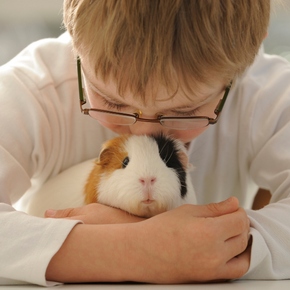
Why choose rabbits, hamsters, or other small furry pets for your child
When looking to get your child’s first pet, many parents will automatically think, ‘small furry animal’. Whilst some small furries can be rewarding first pets, they also require a lot of dedication and commitment to make sure they are looked after appropriately. Get Towcester Vets’ advice on what to consider before buying a small mammal for your child.
Common small animals kept as pets include Guinea pigs, Rabbits, Hamsters, Gerbils, Mice, and Rats. According to our Burcote Road nursing team, they have many differences besides appearance, so it is crucial that you fully research the species and what their requirements are before committing to any of them. For example, Guinea pigs are typically easier to handle then rabbits, meaning they might make a better option for your child.
Other things that need to be considered include:
- Home setup – what do you need?
- Who is responsible for cleaning them out and feeding?
- Lifespan of the animal?
- Do they need a companion?
- Are they nocturnal?
- Do they hibernate?
Having a good understanding of the above questions means that choosing the most suitable pet should be easier. Read our helpful guide on the different types of small furries you can keep as pets – download our Small Furry Pet Stats here.
Home setup needed for small furry pets
Some small animals need to be kept outside in a hutch (that can be brought inside a shed or indoors in very cold weather and has shade from the sun), whilst some need to be kept indoors in a suitable cage. Either way, they will need decent-sized housing with room to grow, especially if they need a companion. Small furries also need items inside their housing for enrichment, such as toys, hideouts, exercise equipment, and things to gnaw. All species need cleaning out regularly, so estimating how long this will take and deciding who is responsible is very important.
Life expectancy
Some small animals may only have a life expectancy of 1-2 years while others may live 10+ years. This may be a deciding factor when choosing your child’s pet, as it will give you an idea of the long-term commitment that you are making.
Veterinary care
Regular health checks at our Towcester vet practice will help our team to spot any problems that need addressing. Just like cats and dogs, each type of small furry pet comes with their own set of typical health problems you should make yourself aware of before buying one. For example, rabbits and guinea pigs can be prone to deadly flystrike if their housing is not kept clean. Some small furries have a higher risk of respiratory issues and lumps too.
Small furry pet companions
When it comes to companionship, some small animals may be happy to live on their own whilst others need a companion to be happy and healthy. Same or opposite sex pairings and groups will depend on the species, and the individual animal, as not all will get along – then comes the question of neutering. The veterinary team at Towcester Vets advise that rabbits and male guinea pigs are typically neutered if living in same-sex pairs or groups. This is also important as multiple animals means more responsibilities and costs.
There are many places you can go to for advice on what small animal may suit your family most. These include speaking to the Vet Nurses at your local veterinary practice, pet shops, reliable internet sources, and rescue centres. Doing the research at the beginning will make the whole process more rewarding and easier in the long run to ensure your pet is kept healthy and happy, and your child has a pet they can enjoy being responsible for.
Did you know that some animal rescue centres also have small furry pets in need of a loving home?
Remember to check out our helpful Pet Stats to aid your decision making:
Download our small furry pet stats

Why all Northamptonshire cats need a microchip in 2022
You have probably heard the old saying about cats and curiosity being a dangerous combination, so how do you give them any kind of safety net as they embark on a life of adventure? Identification, that is how.
June is National Microchipping Month, so whether you have an indoor or outdoor cat, read on to discover why all cats in Northamptonshire need a microchip, by law, in 2022.
Find your lost cat
While some cats probably shudder at the thought of leaving their favourite sofa, let alone the back garden, other cats can wander for miles. What all cats have in common though, is the ability to get picked up by a helpful passer-by or an animal warden for looking lost and taken to a veterinary practice or rescue centre.
Most cats do not wear a collar and ID tag so without any form of identification, reuniting the two of you could be impossible. When the owner cannot be found, cats are typically put up for rehoming.
The team at Towcester Vets recommend cat microchipping as the best way of ensuring your feline friend can be quickly reunited with you.
New cat microchip law UK
‘Lost & found’ isn’t the only reason our Towcester veterinary team recommend cat microchipping.
DEFRA (Department for Environment, Food and Rural Affairs) has announced that cat microchipping will become compulsory in the UK in 2022 as part of a larger animal welfare action plan. The move is aimed at making more cats identifiable, in turn helping with issues such as cat thefts, strays, and deceased cats left by the road following traffic accidents.
This new law, which will carry a fine of £500 for non-compliance, is welcomed by many cat charities including Cats Matter and Cats Protection.
As part of the legislative changes, all cats over 20 weeks of age (unless there is an animal health or welfare reason certified by a Vet) must be microchipped by law. This coincides with the typical age kittens can be neutered from, so both procedures can be done by our team here at Towcester Vets before your kitten ventures outside. If your cat is already neutered, microchipping only takes a few minutes.
What does cat microchipping involve?
Microchips are tiny electronic devices, no bigger than a grain of rice, which are injected under the skin on the back of a cat’s neck. The procedure is quick and perfectly safe, and your cat will receive lots of cuddles from our team.
The microchip will carry your unique registration number, which links to a database where all your contact information is stored. One of our Towcester veterinary surgeons or nurses, and staff at some animal shelters, can scan the microchip and access the database to get your details.
It is likely to also be an offence to not keep your contact details up to date on the database, as it is with dogs. And why would you not? Out of date contact details are no use to your cat!
Do not delay, book your cat’s microchipping today
At Towcester Vets, we recommend that owners get ahead of this new law and get their cat microchipped as soon as possible. The unthinkable could happen today and a microchip could make all the difference in reuniting you with your cat.
Towcester Vets share how to keep rabbits cool during summer
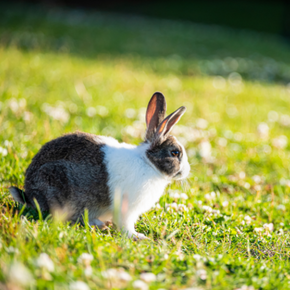
Due to their thick covering of fur, rising temperatures can become dangerous for rabbits as summer approaches. Rabbits can easily overheat and develop life-threatening gut problems or disease with these seasonal changes. Do not panic, the team at Towcester Vets are here to help you learn how to prepare your small furry pets for the warmer months ahead.
Rabbit checklist for dealing with rising temperatures
A big problem for rabbits during summer is overheating. Here are some ways to reduce that risk:
- Position the hutch in the shade – if outdoors, maybe think about creating a burrow (that they cannot escape from) to help them mimic their natural ‘wild’ behaviours
- Rabbits do require some time in the sun during the day to get the vitamin D they need for digestion – give them short amounts of supervised time outdoors with shaded areas
- Make sure their water bowl/bottle is filled up with fresh water more regularly
- Wrap an ice pack or a 2-litre drink bottle of frozen water in a towel for them to lean on
- Provide a cooler space to lie on such as a cooling mat or a cold tile
- Use water in a misting spray bottle on their ears to cool them down – never soak them as this could put them at risk of respiratory problems if they catch a chill
- Make sure their hutch is well-ventilated – a fan can be used but avoid pointing it directly at your bunnies and make sure they have enough space to move away from it if they want to
- Give frozen veggies as a cooling treat
The signs of heat stroke in rabbits include:
- Panting
- Drooling
- Disorientation
- Increased heart rate
- Head tossing
- Red or hot ears
- Seizures or a coma
If your rabbits are suffering from heat stroke, do not submerge them in water or leave them unattended for long periods of time. Dampen their fur, offer them cool water, and call our Burcote Road vet practice right away for advice.
Despite the warmer weather during spring and summer, there can still be cold spells, so make sure there is extra insulation and bedding if required. In addition, spring grass (which is high in sugars) can cause gut issues in your rabbits, so gradually introduce them to this within their feed.
Summer rabbit diseases
Another topic of concern is disease. During warmer months, the risk of diseases such as flystrike, myxomatosis, and VHD (Viral Haemorrhage Disease), as well as parasite infections increases. You can significantly reduce the risks with optimal hutch hygiene and the correct vaccinations.
A great way to reduce both the risk of overheating and disease is grooming. Brushing can help to remove some of their thicker winter fur and any debris, which will help to cool them down. If your rabbits have long fur that needs a trim, it is wise to consider using a professional groomer for this as a rabbit’s skin is quite thin and easily damaged.
Should I bathe my rabbit to cool or clean them?
Rabbits tend to keep themselves meticulously clean. If your rabbit gets extremely dirty and needs some help, spot cleaning is the safest method. If they get hot, it is best to follow the advice above. Being bathed could frighten your rabbit, leading to injury from thrashing about. Also, they could catch a chill and suffer from pneumonia, respiratory infections, hypothermia, and other life-threatening health conditions. If your rabbit is struggling to clean themselves or you spot urine or faeces on their fur, they may be at risk of flystrike and in need of veterinary care.
We hope our tips on how to keep rabbits cool and healthy in summer will help you have a happy and trouble-free season with them in Northamptonshire.

Towcester Vets’ nurses give vital pre-summer dog advice
Now the sun has joined us, it is time to think about what we need to do to prepare our pets for summer. Towcester Vets’ nursing team have come up with a helpful list for dog owners in Northamptonshire.
Get our Summer Dog Safety Guide
There are many ways in which you can prepare dogs for the upcoming warmer months. According to our Burcote Road Registered Veterinary Nurses, these include:
- Grooming
- Parasite control
- Vaccinations
- Preparing for upcoming holidays
- Reminders on keeping pets cool
- Exercise guidance
Let us look at each one in more detail so you can get your companion ready and raring to go for the summer fun ahead!
Dog grooming
The first action is to ensure your dog’s coat is ready for the warmer weather. Some breeds need to be groomed regularly to keep their fur under control. Breeds like cocker spaniels, poodles, and many others will also need a trip to the groomers for a fur clip to keep them cool in the heat. The groomer may be able to trim your dog’s nails too, or you can ask our nurses to take care of this for you. Nail clips are helpful as dogs are more likely to do lots of walking across softer surfaces like grass and sand and whilst these have many benefits, they do not help to keep nail length under control.
Parasite control
Next, it is essential to be on top of your dog’s routine parasite control. Again, because of the warmer weather, you are more likely to walk your dog across areas where other species may carry parasites such as ticks. Fleas also start to become more active with the warmer weather so make sure your pets are regularly treated to avoid any infestations. Daily vacuuming and the occasional home flea treatment can help even if your dog does not have fleas, as they can arrive via other pets and on your clothes and shoes.
Vaccinations for dogs
Annually vaccinated dogs will have optimal protection against contagious, harmful diseases. With the hustle and bustle of daily life, sometimes booster jabs can become overdue. Without sufficient protection, your dog is at greater risk of exposure to infections whilst they are enjoying their summer adventures.
Summer holidays
You may be starting to think about your holiday plans for the year, here are our nurses top tips:
- If you are leaving your dog with someone, be sure that they are a registered, licenced, and insured business with good animal welfare regulations.
- If you are unsure how your dog will cope in kennels, do a practice run where they just stay for one night at a time to get used to it. You will need to make sure all vaccinations are up to date and you have the signed certificate ready for when you drop them off.
- If you are taking your dog on holiday with you, be sure to check that your accommodation is happy to have pets on-site, and you have an Animal Health Certificate and any other relevant documents if travelling abroad (you will need to organise these several weeks in advance).
How to keep dogs cool and safe in summer
Keeping dogs cool in summer can be challenging but vital to ensure they do not become unwell. Our Burcote Road Vet Nurses recommend considering things like hydration, shade, changing when your dog exercises, and ways to cool them down and deal with emergencies. To help you, we have a handy guide on the subject – download it here:
Download our Summer Dog Safety Guide
Make sure to pop our contact number in your phone to get emergency care and advice, if you don’t have it already: 01327 350239
Did you know May is Veterinary Nurse Awareness Month? Why not share why your pets love our Vet Nurses on our Facebook page? If you include the hashtag #VNAM on your post, you can help to spread the word about our fantastic nursing team!

Understanding Ragwort poisoning in horses
The ingestion of Ragwort, Senecio jacobea, is one of the most common causes of poisoning in horses in the UK, so it’s worth understanding what it looks like and how best to try and stop it from getting into your horse. In this short article, Holly Gimmler, one of our equine vets covers all the basics you need to know about Ragwort poisoning.
Ragwort is a tall daisy like plant with yellow petals. It is a weed that commonly grows on road verges and some pastures. It contains a toxin, pyrrolizidine alkaloid which makes Ragwort one of the most common causes of poisoning in horses in the UK due to its widespread nature.
The plant tastes bitter so horses will generally avoid eating Ragwort if it is in their pasture unless the pasture is of poor quality, where there is little else to eat, or if the plant is disguised in hay and therefore less noticeable. There have been welfare case incidents where ragwort toxicity has occurred on particularly barren pasture.
How do I know if my horse has ragwort poisoning?
Clinical signs or Ragwort poisoning are observed when a large volume of Ragwort has been consumed over a long period of time, resulting in liver damage.
Signs of liver disease include:
- Inappetence (lack of appetite)
- Lethargy
- Weight loss
- Abdominal pain (colic)
- Photosensitisation, which presents as sunburn, especially on unpigmented (pink) skin
- Jaundice
- Compulsive walking, head pressing or convulsions are signs of hepatic encephalopathy where the brain is affected by rising levels of toxic substances in the blood, resulting in neurological signs
Our vets can test for signs of liver damage by taking a blood sample, which we run in our lab. This looks at specific liver enzymes which usually show elevated levels in affected cases. However, this does not prove the cause of poisoning and a liver biopsy and subsequent analysis of the liver cells under a microscope is the most definitive way of diagnosing the condition and the extent to which the liver is damaged.
How do we treat ragwort poisoning?
Unfortunately, there is no definitive cure. Treatment is therefore based around supportive care. It can take a long time for horses to recover and in severe cases the damage may be irreversible.
Our vets may recommend liver supplements, including vitamin B12 and milk thistle, which can be given in feed. Re-sampling of blood is often recommended in order to ascertain whether liver enzymes are decreasing which indicates that your horse is responding to treatment.
Sadly, in severe or advanced cases, once neurological signs are seen, the chances of survival are grave.
To help your horse avoid Ragwort, follow these simple steps
- Pasture management is key in preventing Ragwort poisoning. So, regularly check your pasture (and the area around your pasture) for Ragwort and if you find it,
- Pull the plant out of the ground, whole if possible, including the roots. This is best done in early Summer before flower heads mature and when the ground is wet.
- Also remove the younger “rosette” stages.
- Avoid cutting the stem as this can encourage growth, or spread seeds.
- Make sure you wear gloves when doing this.
- Do not dispose of the plants onto muck heaps or leave in horse’s pasture as the plant can re-seed
- Be sure to check that there are no Ragwort flowers present in hay
- Ensure your horse is in good health all year round
- See the BHS toolkit guide for more information
If you suspect your horse has ingested Ragwort, then please contact our vets immediately on 01327 811007
Holly Gimmler BVSc MRCVS
Holly joined our equine veterinary team in July 2021 having just graduated from the University of Liverpool. During her studies she gained valuable experience treating equine emergencies and caring for inpatients under the guidance of top specialists at the Philip Leverhulme Equine Hospital. She enjoys all aspects of equine veterinary work and has gained particular interests in anaesthesia, medicine and reproduction.
References
Bhs.org.uk. 2022. Identifying Common Ragwort in England | The BHS. [online] Available at: <https://www.bhs.org.uk/our-work/welfare/our-campaigns/ragwort-toolkit/toolkit-dealing-with-ragwort-england/identifying-ragwort> [Accessed 27 February 2022].
Travel sickness & safety: Our vet has advice for dogs, cats & small furries
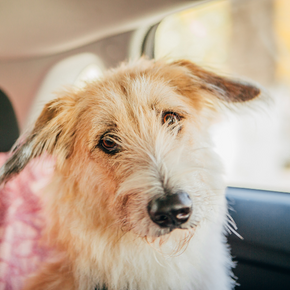
Travelling with your dog can be a joy, especially when you reach your destination. Being able to travel with any pet is a necessity though, for visits to the vets or the groomers, and taking them to a pet sitter or boarding facility.
Are you wondering how to travel safely, or how to stop travel sickness in dogs, cats, and other pets? To support National Pet Month, which promotes responsible pet ownership, our Vet team has some helpful travel advice just in time for the summer holiday season.
Get our Pet Travel Sickness Guide
Ensuring an incident-free journey
Pet travel sickness and safety go hand in hand – making sure your pets feel safe in the car can help to reduce their anxiety and sickness. Motion sickness is more commonly seen in puppies and other young pets because their ear structures used for balance aren’t fully developed yet. Stress can also lead to travel sickness, which can affect all pets so if you only ever drive your pets to the vets to be poked and prodded (we offer other services too), anxiety may lead to nausea and vomiting.
Practising safe car travel will not only help to keep your pets safe, it will also help to keep you out of trouble with the law – letting your pets be a distraction whilst driving is a fineable offence. So, let’s dig in. Our team of Head Vets has listed some important pet travel safety advice to help you below, and you can download our handy Pet Travel Sickness Guide too.
Cat & dog travel sickness symptoms and small furry stress
First, our Vet team advises pet owners to be aware of cat and dog travel sickness symptoms: inactivity (mostly dogs), yawning, whining/meowing, excessive drooling, vomiting, and smacking or licking lips. Stress in small furry pets presents in many ways including a reluctance to move, not eating or toileting, hiding, and aggression.
10 travel safety tips for pets
Out team has shared their top tips for reducing the risk of accidents, injuries, stress, and a driving penalty with your pet in the car:
- Never let your pet travel in the front passenger seat as they could be seriously injured if the airbag releases.
- Secure dogs on your back seat with a seatbelt and harness, or in a dog crate on the back seat or in the boot. If using a seatbelt, never clip it to your dog’s collar, and consider using a dog travel seat that keeps your dog contained and stops them from slipping into the footwell.
- Secure cats & small pets in a secure cat or small pet carrier either on the back seat (with a seat belt if possible) or in a foot well. A small pet carrier must have air holes, and it is advisable to add a deep bed of hay plus a shelter to hide in. Put some cucumber (or moist veggies) in with hamsters and guinea pigs so they have a water source on the journey.
- Lie crates and carriers as flat as possible and put comfortable bedding in them.
- Make sure nothing can fall on your pet or cause them harm i.e. avoid piling up suitcases, bags, tools, or other items next to them and keep food out of their reach.
- Reduce stress and avoid fighting by never putting pets in the same crate or carrier – pet fights whilst driving can be very dangerous for your pets, you, and other drivers. Plus, if you have an accident, your pets may bang into each other and cause further injury.
- In warm weather, use sunshades on your windows, try to avoid travelling at the hottest times of the day and long journeys, and never leave your pet in a parked car.
- Always take water and a bowl with you on car journeys and take regular breaks to check your pet is ok – avoid using cooling coats as these can dry out and trap the heat in.
- Reduce other distractions in the car such as music, so you can focus on driving first and foremost, and can hear anything concerning that you need to park up and address.
- Take extra care with your speed, as bumps and sudden stops will encourage you pet to be thrown around inside the car.
So, there you have it – ten excellent pieces of advice to help you ensure a safe journey for you and your pets. We haven’t forgotten about the dreaded travel sickness – you can get our tips for reducing this here in our handy guide:

Sudden Death in Lambs
Sudden death is sadly a common and frustrating problem in lambs. Whilst many people overlook this, it is important to investigate because many causes of death can be avoided with management practices such as vaccination or targeted treatments.
The main causes of sudden death in lambs include:
Clostridial disease
Clostridial disease is one of the most common causes. Clostridial bacteria naturally inhabit the intestines but if the gut environment changes this can lead to multiplication, production of toxins and death. This generally seen due to increased feed intakes and changes in diet (pasture and grain based). The most common clostridial diseases in lambs are pulpy kidney and lamb dysentery (both covered by vaccination).
Acute pneumonia and septicaemia
Acute pneumonia and septicaemia are also regular post-mortem findings. This syndrome is most often associated with stress. Several bacteria are responsible, including Mannheima Haemolytica and Pasteurella Multocida. These bacteria are found in healthy sheep, however under periods of stress these bacteria multiply, invade the lungs and enter the bloodstream causing septicaemia and death.
Parasites
Parasites can also be a cause of sudden death. Nematodirus battus outbreaks occur when large numbers of Nematodirus eggs hatch simultaneously in fields grazed by lambs (generally 6-12 weeks old). Severely affected lambs can die suddenly This large-scale hatching requires a chilled period followed by a warmer spell and can be predicted. For the current forecast, please visit the SCOPS website or see our website for more details.
Coccidiosis
Coccidiosis occurs in a similar age group to Nematodirus but can occur as early as 3 weeks. Sheep rapidly gain immunity to this parasite through exposure but if they meet a high challenge before this immunity is in place then disease will occur. Scour is a common finding but if severe gut damage occurs then sudden death can result.
Post-mortems are the best way of investigating. To make the most of this, it is vital we choose the best candidates. Lambs should be fresh and not have suffered predation – we can get answers from those missing eyes but it’s hard to get an answer when they are missing most of their vital organs!
We can carry out post-mortems at the practice or we can use APHAs subsidised service. Free carcass collection is often available depending on your postcode. All supplementary testing is included in the price and a full comprehensive report is received making this excellent value for money.
Please call us on 01327 350239 or email admin@towcestervets.co.uk, if you’d like to talk to one of our vets about this service.

Take Towcester Vets’ safety quiz for preventing dog bites
Dog bite prevention week is recognised in many countries between April & May each year to bring attention to the risk of dog bites and share preventative advice. In this article, the team from Towcester Vets are sharing important tips and resources to help Towcester residents prevent dog bites in children and adults.
April 1st – May 2nd is also National Pet Month, in which responsible pet ownership is the theme and a perfect backdrop for this article’s topic.
13 tips for preventing dog bites
Most dog bites don’t come from dogs who are deemed ‘aggressive’, they occur in the home with family dogs or dogs who are well known. Pets who are described by their owners as placid, loving, and “wouldn’t hurt a fly” can all snap and bite if they feel agitated, threatened, frightened, vulnerable, unwell, or in pain.
As well as the obvious physical injury, a dog bite can cause complex psychological issues. If a dog bites a child (or lunges at them) especially, they can develop a long-term fear of all dogs. Dogs can ‘learn’ that this behaviour is needed to stop the action that is bothering them. This is a real shame as children and dogs can both benefit from forming a close bond together.
Therefore, it is advisable to practice these 13 do’s & don’ts of dog interactions:
- Do choose the right dog breed for your family and home setup – remember, all cute puppies grow into adult dogs with big teeth
- Do ensure your puppy’s (or older dog’s if you missed this stage) socialisation experiences include being around children
- Do train your pet from a puppy into adulthood on how to be well-mannered in the home and out & about
- Don’t use fear to train a dog as this is harmful and can lead to unwanted reactions in everyday situations
- Don’t assume your dog won’t bite just because you perceive it not to be in their nature
- Don’t leave children alone with dogs
- Do teach children from a young age how to behave around dogs, including not playing aggressive games with them, pulling their ears or tail, or anything else that may agitate them
- Do act calm around dogs, especially if they are unfamiliar to you
- Do supervise children feeding or walking a dog
- Don’t let your child discipline a dog
- Don’t invade a dog’s space without their permission – let them come to you (avoid letting young children hug & kiss dogs)
- Do teach children to always ask the owner’s permission to stroke their dog and where the dog likes to be stroked
- Don’t allow your child to approach a dog in someone else’s garden or car
Socialisation & training
Puppy socialisation begins not long after birth, when they will learn how to be a puppy from their mother and siblings. When puppies go to live with their new owners (typically from 8 weeks old), there is a key window up to 12 weeks of age, during which puppies should undergo more practical socialisation with their new owners. Your puppy’s brain will be like a sponge at this age, absorbing all the sights, sounds, smells, tastes, experiences, and opportunities to learn that they can. Most older dogs can be socialised too, however it may take a lot more time and patience.
An excellent resource for puppy socialisation is The Puppy Plan from Dogs Trust
Socialisation and training (into adulthood) are not about obedience. They are about building confidence and developing clear communication with your dog. If your dog understands your request and how to respond to it and has self-confidence, they are less likely to get fearful or frustrated, which are both common causes of dog bites.
Ask our Towcester nurses for puppy socialisation advice on our Facebook page here
Learn how to be safe around dogs
The team from Towcester Vets recommend these helpful resources below to help your whole family become smarter and safer around dogs.
First, take our Dog Safety Quiz to test how much your family members currently know.
Then, work through these Dogs Trust resources and get everyone to re-take our Quiz.
Remember, don’t give the answers away until after retaking the quiz!
Let us know how you got on by sharing your results on our Facebook page.

Calf Scours – Prevention is Possible!
Scouring calves can be frustrating but prevention is possible through good hygiene, colostrum management and an understanding of the causes of disease on your farm.
1. Good hygiene
- Good hygiene is essential for preventing the build up of infectious pathogens
- Regularly muck out and disinfect calving pens
- Dip navels in iodine immediately after birth and again 4 hours later
- Isolate any sick calves and clean out areas that have been contaminated
2. Colostrum management
- Colostrum gives calves antibodies to help protect them from disease
- Ensure colostrum is of good quality
- Consider metabolic profiling cows 2-3 weeks before calving to ensure they are in optimum condition to produce high quality colostrum
- A refractometer can be used on farm to assess colostrum quality
- Ensure calves receive the right quantity of colostrum, quickly enough
- Calves should receive 3l of colostrum within 2 hours of birth, and a further 3l within 24 hours
- Blood samples can be taken from calves within the first week of life to assess colostrum uptake
3. Quick and effective treatment
- Isolate scouring calves away from other calves and clean any contaminated areas to prevent spread to other calves
- Give supportive care
- Keep calves warm and dry; consider using calf jackets
- Keep calves hydrated with oral fluid therapy
- Give 1-2l of electrolytes 4 times daily
- Alternate with milk every 4 hours
- Diagnose the cause to inform treatment
- Take a temperature
- Normal temperature should be 38.0 – 39.5°C
- A high temperature indicates a systemic bacterial infection
- A low temperature may occur with severe dehydration
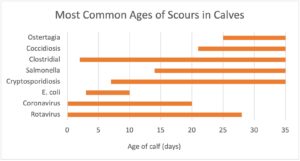
- Consider the age of the calf since different causes are associated with different ages of calf:
- Take a temperature
-
-
- Use an on farm calf scour test kit to diagnose E. coli, Coronavirus, Rotavirus and Cryptosporidiosis
- Submit a faecal sample
- We can look at faecal samples in house for coccidia and worm eggs, and carry out a scour test if you haven’t got one on farm
- We can send faecal samples to the lab to test for Salmonella, E. coli, Cryptosporidiosis, Rotavirus, Coronavirus, Coccidiosis and worms
- Treat appropriately
- Antibiotics
- Injectable antibiotics are essential for treating bacterial infections including E. coli and Salmonella, indicated by a high temperature
- It is also beneficial to treat calves with antibiotics even if they are infected with viruses or parasites, since they are at higher risk of bacterial infection
- Anti-inflammatory pain relief
- Meloxicam (Animeloxan/Meloxidyl) reduces inflammation and pain associated with intestinal disease
- Specific treatments
- Cryptosporidiosis can be treated with halofuginone lactate (Halocur)
- Coccidiosis can be treated with Baycox or Vecoxan
- Ostertagia can be treated with most wormers
- Other drugs
- Steroids or anti-spasmodics may be helpful in severe cases of diarrhoea – talk to a vet about whether these are appropriate
- Antibiotics
-
4. Specific preventative measures
- Use diagnosis to inform your prevention strategies
- Cows can be vaccinated for rotavirus, coronavirus and E. coli so antibodies pass to calves in colostrum
- Pasture management is important in controlling coccidiosis and worms
- Talk to a vet about how to tailor a calf scour prevention strategy to your farm


Identifying & Preventing Staggers in Cattle & Sheep
Staggers is caused by low blood concentration of magnesium and affects both sheep and cattle. It is most commonly seen in adult lactating animals grazing lush, fast-growing grass pasture but we do see a number of cases in housed animals every year. Magnesium isn’t stored in the body and therefore the main source is from food. Absorption will vary with how quickly food passes through the digestive tract and there will be a higher demand during lactation. If feed intakes are reduced due to stress, illness or poor weather then this will also affect magnesium absorption.
Magnesium is important in normal neurological function. Clinical signs therefore include:
- Sudden death
- Initial excitability with high head carriage, twitching of muscles and incoordination.
- Separation from the group. Animals may have startled expressions, exaggerated blink reflex and frequent tooth grinding.
- Rapid progression to periods of seizure activity
Animals found with clinical signs require immediate treatment with subcutaneous Magniject whilst waiting for veterinary attention to administer a combination of calcium and magnesium slowly into the vein. Stress should be minimised during this time and unfortunately there is always a risk during treatment that the extra stress could kill the animal. If treatment is successful, animals should be offered concentrates and good forage to prevent relapse.
In cases of sudden death, we can confirm the diagnosis by measuring magnesium concentration in the fluid around the eye soon after death. Blood sampling a few other animals in the group can also be useful as the majority of the group may be affected without showing obvious clinical signs.
Factors influencing the availability of dietary magnesium include magnesium levels in the soil and grass which vary considerably. High levels of potassium or ammonia on pasture inhibit magnesium absorption. Lush pastures are low in fibre and increase the rate of passage of food material through the rumen reducing time for magnesium absorption.
In terms of prevention, options include:
- Medicating the sole water supply with soluble magnesium salts such as chloride, sulphate or acetate. These salts aren’t very palatable so follow directions for use carefully.
- Intra-ruminal boluses which give a reliable slow release of magnesium into the rumen over periods of high risk.
- Magnesium buckets though these may not be used by all animals in a group and problems can still occur.
- Supplementation is particularly important during stormy weather when roughage, such as straw, can be beneficial by slowing rumen throughput and allowing time for magnesium absorption.
- Feeding concentrates containing magnesium will also help to provide sufficient amounts.